As I continue to look at different policy models for Indigenous education some of the challenges that I have come across relates to ambiguous or general goals. Countless policies identify Indigenous student success as the outcome or measure of policy but this is far too general. Taking into account the colonial structure of the education system and the holistic nature of education championed by Indigenous communities, what truly is the definition of success? How do we measure the strength of a students character or their spiritual connection to land and community?
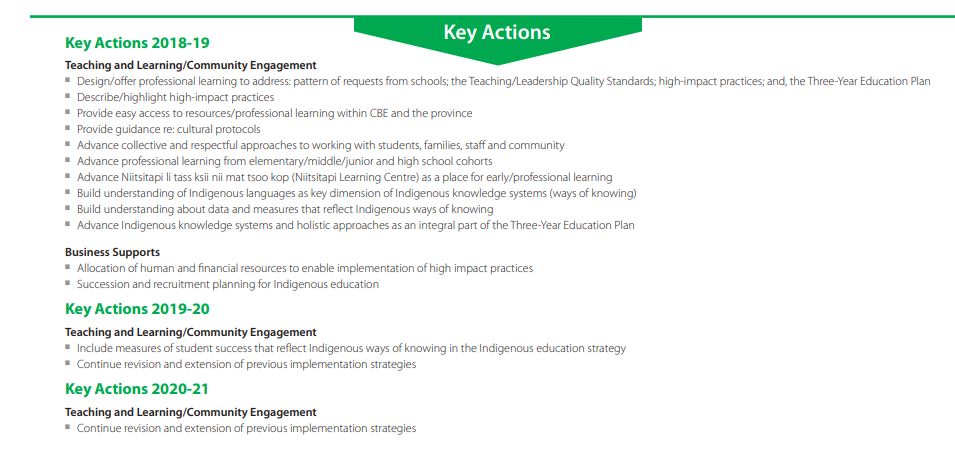
I found this document as it was connected to the 3 year Indigenous Education Strategy outlined by the Calgary Board of Education. I found it interesting as it identified key actions that were to take place to support their policy. Of particular interest is the segment under 2018-19 that states the following: Build understanding about data and measures that reflect Indigenous ways of knowing. This is a promising development in my policy research that shows school districts are becoming more conscious of potential bias in data collection methods that do not support Indigenous students. I really struggle professionally with the emphasis placed on standardized assessments as the sole indicators of teaching and learning. It is refreshing that this district is looking to be innovative in their approach to assessment and is attempting to accumulate data that is connected to traditional ways of knowing. Through my engagement in the course work it would be possible to look at more comprehensive student learning profiles that incorporate student driven inquiry methods and self-assessments that engage in reflective practices to incorporate how knowledge is not only acquired but fits into the Indigenous perspective.
Finally, there are some weaknesses in this document that are present in the 2019-20 section that state: Allocation of human and financial resources to enable implementation of high impact practices. If I have learned anything from this course it is that you cannot just throw money and people at initiatives and believe that your policy will be successful. In fact, if we look at federal policy from the Canadian government from the 1960’s onwards it could be argued that the financial investment made in Indigenous Education has been poorly targeted and lacked measurable steps to improve the future for Indigenous education. My previous journal post highlights the struggles that school districts can endure when they allocate human resources such as “Indigenous Learning Leaders or Positions” without taking the time to look at decolonization and Indigenous pedagogy. With these areas identified in policy there can be a clearly articulated vision for larger urban school districts that avoids general outcomes and moves towards decolonizing practices in the classroom.
 PME 821 Professional Connections Journal